
The app does not add features. It adds a second door.
Buyers ask whether the Bluetooth version is worth stocking. The honest answer is not the one that sells more modules — the app opens a second way into hardware that already does the work.
Two questions come up on nearly every switch panel enquiry, and they sound like the same question.
Do we stock the Bluetooth version or the plain one?
Can a customer add the wireless remote later?
The first has an answer most people get backwards. The second is simply no — and it is an expensive thing to find out after the customer has already bought.
Both make sense once you see how the range is layered. There are four steps, and each one decides what the step above it is allowed to do.
It starts with the switching, not the radio
The first fork is not wired versus wireless. It is relay versus electronic.
The TC-SW6R switches through physical relays. A relay is a mechanical contact — it closes, it carries current, and that is the whole of it. There is no processor in the path for a radio to talk to. You cannot add a Bluetooth module to a relay panel at any price, because there is nothing for the module to control.
That is not a shortcoming. Relay switching is diagnosable with a test light on the side of a track, it takes standard blade fuses you can buy anywhere, and it carries a 3-year warranty. For a customer who wants nothing to pair and nothing to update, it is the right product.
Everything else in the range is electronic — solid-state switching, no contacts to pit or weld. Electronic switching is what makes app control possible in the first place. So when a buyer asks about Bluetooth, the real question underneath is which switching they are buying.
The wired panel is the whole system
This is the part that gets described wrong, usually by us in the trade rather than by the customer.
An electronic panel is not a base model waiting for a phone. Take the TC-SW8B: eight circuits, individually rated at 2×30A, 2×20A, 2×10A and 2×5A, ≤60A total, 12–24V DC, IP65, and a rated range of -40°C to 105°C. The MODE button sets toggle, momentary, flashing or strobe on each circuit. Seventy OEM icons come in the box. The backlight sets its own brightness off an ambient light sensor.
None of that waits for anything. Every circuit, every mode, every icon works on the buttons with no phone within a hundred kilometres. That matters for a reason that has nothing to do with convenience: a control system whose primary interface is a device with a flat battery is not a control system. The panel is the interface. Everything else is additional.
One thing to keep straight across the 8-gang models: the ambient light sensor is on the TC-SW8B and the TC-SW8W. The older TC-SW8 does not have it, and its backlight description reads almost identically, so check the model rather than the sentence.
The module adds a door, not a room
Now the question that gets answered backwards.
On every electronic panel, Bluetooth is specified in or out at order time. It is a module, not a version — same panel, same ratings, same enclosure. And the usual sales line is that the Bluetooth one does more.
It does not. Here is what the app actually controls, from its own four tabs:
- Backlight colour, per switch
- Icon, per switch — the same 70-icon set that ships on the sticker sheets
- Mode, per circuit — toggle, momentary, flashing or strobe
- Grouping, so one press drives several circuits at once
Three of those four are things the hardware already does on its own. The colour, the icons and the per-circuit mode are all set from the panel. Grouping is the one thing only the app does.
So what the module buys is not capability. It is reach — a second way into the same system, for the times the panel is not where you are. That is a real thing to want, and it is worth saying plainly rather than dressing up:
Specify it in when the panel ends up somewhere awkward to reach, or when the customer sets the thing up once and wants the fiddly configuration done sitting in the passenger seat rather than upside down under a dash.
Leave it out for fleet and rental work, or any customer who would rather have one fewer thing to pair. It is not a downgrade, and it should not be sold as one.
If you stock both, this is the sentence that saves an argument later: the app changes how you reach the panel, not what the panel can do.
The remote is a different kit, and you can see it on the shelf
The second wireless thing in the range is not Bluetooth at all, and this is where the costly misunderstanding lives.
The TC-SW8W ships as a kit — a control box, a wired main panel for the dash, and one wireless remote panel. The remote talks to the control box over its own 433 MHz radio, at about 30 metres line of sight. It needs no signal wire and mounts wherever it is useful: the tray, a roof console, or a pocket.
A remote cannot be added to a wired panel later. Not as an accessory, not as an upgrade, not for a customer who bought last year and now wants one. This is worth being blunt about with your own sales team, because the intuitive answer is yes and the intuitive answer is wrong.
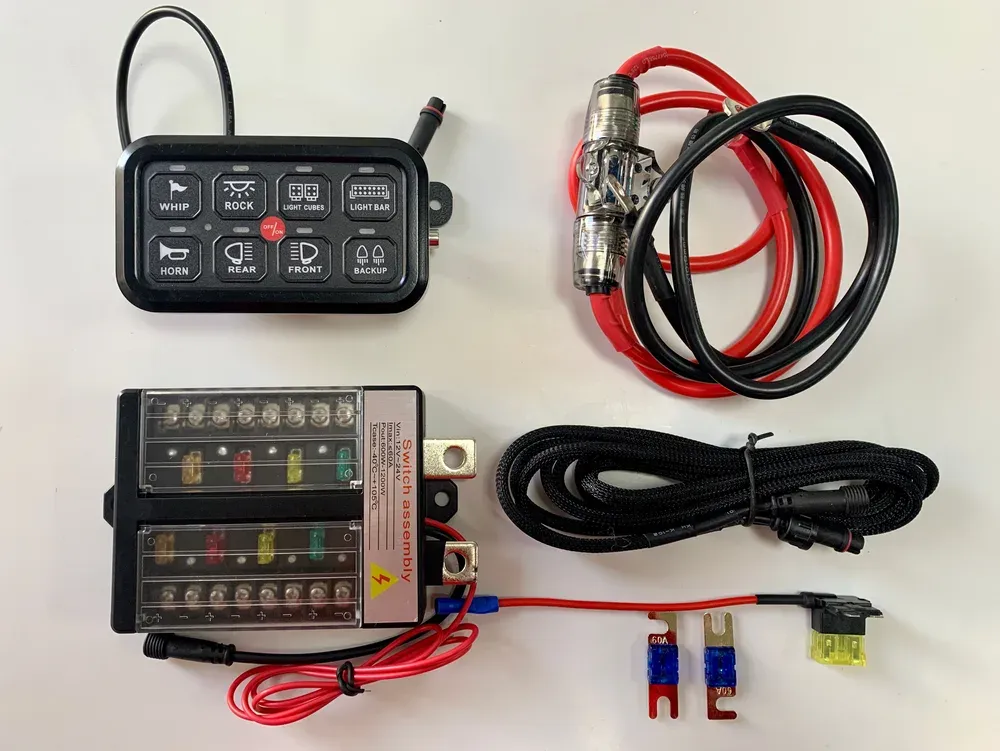
The reason is physical. The TC-SW8W does not use the same control box. The wired panels run a smaller box with the fuse rows sitting under clear covers, so you can see the fuses without opening anything. The TC-SW8W box is larger and sealed black, and the 433 MHz antenna belongs to it — a separate magnetic one on a 2 m lead, stuck wherever there is room rather than fixed to the lid. A customer’s existing control box has nothing for a remote to talk to, and no module changes that.
Here is the wired kit. Two rows of blade fuses sit behind clear covers on top of the box, so you can read which one has gone without undoing a single screw.
Against it, the wireless kit. The box is sealed black with no fuse windows at all, and two things in the layout belong to no wired kit: a 150 mm magnetic antenna for the 433 MHz link, on its own 2 m lead, and a USB lead for charging the remote.
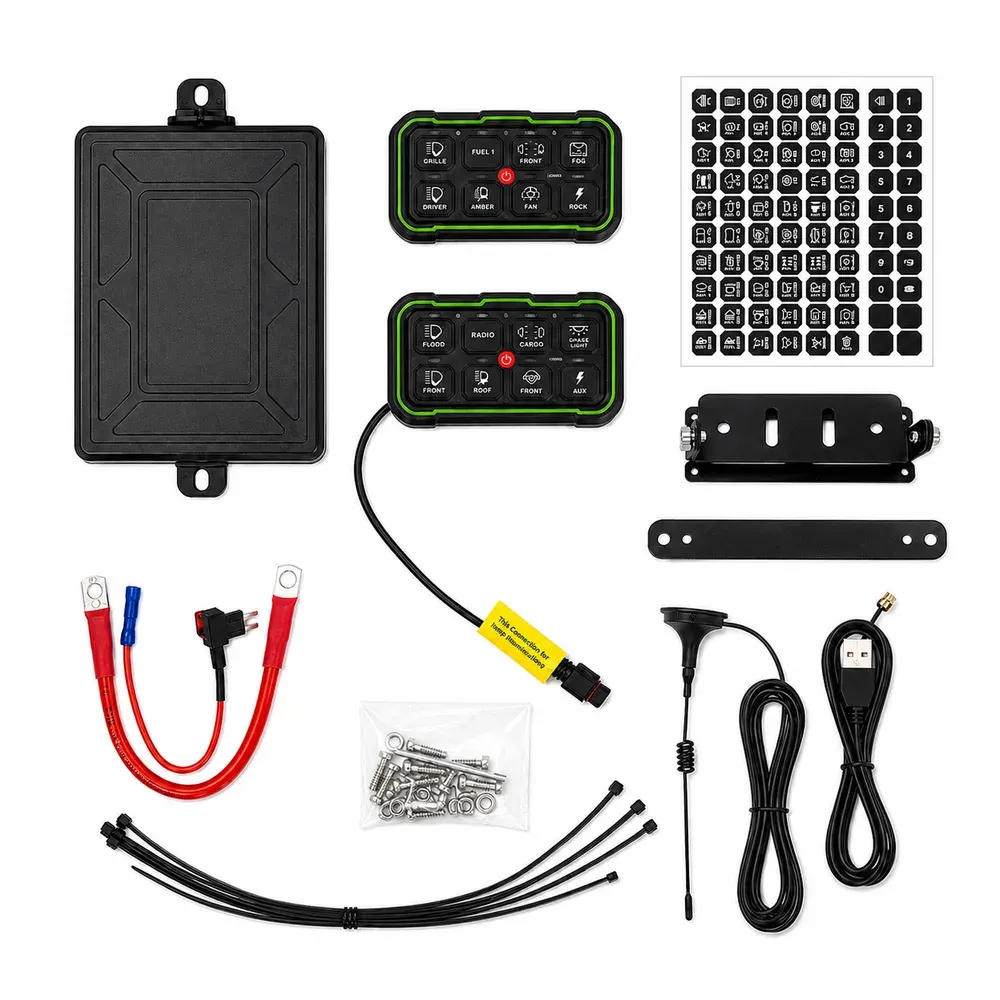
For a distributor that is a genuinely useful thing: the two systems are told apart by looking at the box, not by chasing a model number on a carton. If there is an antenna in the kit, a remote is part of it. If there is not, no module will add one.
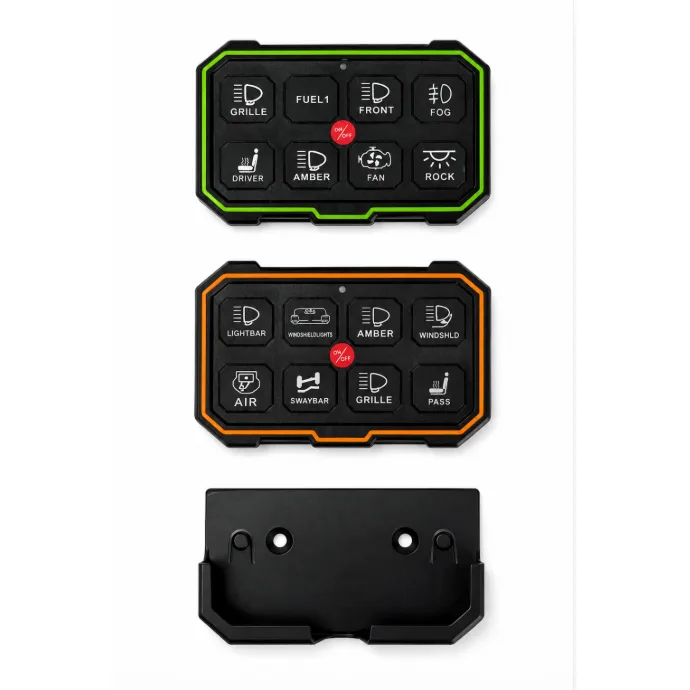
Three more things about the remote that customers ask and spec sheets rarely answer:
- It is not a Bluetooth device. The Bluetooth radio sits in the wired main panel, so the app always talks to the wired panel. Bluetooth is for when you are at the vehicle. The 433 MHz remote is for when you are thirty metres from it. They are not the same feature at two ranges.
- The two panels light themselves differently. The wired panel dims itself from the ambient sensor. The remote’s backlight is white in four steps — high, medium, low, off — stepped by hand with the brightness key. Someone will go looking for an automatic setting on the remote; there isn’t one.
- The remote is rechargeable, and that shows up in the warranty. A 1500 mAh lithium cell, around three hours to full and rated for roughly 300 cycles. At about three hours of use a day, reckon on 38 days per charge with the backlight off, 21 on medium, 9 on high. The TC-SW8W carries a 2-year warranty against 5 years on the wired panels, and the reason is exactly that: a battery is a consumable. The switching hardware underneath is the same platform.
The paperwork layers the same way
This is the part a serious buyer will ask about, so it is better to lead with it than to be asked.
The switch panels hold CE under the EMC Directive 2014/30/EU, an FCC Supplier’s Declaration of Conformity to Part 15 Subpart B, RoHS 2.0 and a REACH SVHC screening. Subpart B is the scope for equipment that does not deliberately transmit — which is the correct category for a switch panel, and for a panel with a Bluetooth module the certification pack for your market is worth confirming against the specific configuration you are ordering.
A 433 MHz remote deliberately transmits, and that puts it in a different regulatory category entirely: an FCC ID rather than a declaration, and CE RED rather than the EMC Directive. Those approvals are not issued yet. They are available for volume orders, and if your market wants that paperwork in hand before you commit, ask us where it stands rather than assuming the panel certificates carry across. They do not, and they were never meant to.
That is not a gap in the panel paperwork. It is a separate filing for a different kind of device. Knowing which one your market asks to see is the difference between a clean customs entry and a container sitting still.
So what do you stock
The layers give you the answer directly.
- Customer wants nothing to pair, nothing to update, and a fuse they can replace at a servo. Relay — TC-SW6R. No module, and none needed.
- Customer wants the ratings and the modes, and will drive it from the dash. Electronic panel, Bluetooth left out. Simplest thing that works.
- Customer will mount it somewhere awkward, or wants grouping. Electronic panel with the module specified in.
- Customer needs to switch circuits while standing away from the vehicle. TC-SW8W, and only the TC-SW8W. Decide this before the order, not after.
The one to get right at the quotation stage is the last one, because it is the only layer that cannot be added later.
Putting your own brand on it
All of the above is available to build under your label — which panel, which switching, whether the module goes in, and what the packaging says. What certification transfers with a logo, and what does not, is its own subject: we wrote it up in what private label actually involves.
Terms are quoted against the actual order and confirmed in writing, not published as a blanket policy. Tell us what you are putting together and we will walk you through where it lands — get in touch.
Specifications and photography for each model are on the switch panel range. If you are working out how many circuits a build actually needs, sizing a panel by current rather than switch count is the one to read first, wireless plus wired on the TC-SW8W compares that kit against the panel it is built on, and where the control box and the antenna go is the one to pass to the workshops fitting it.
Two boxes, one loom
The control box carries the current and lives in the engine bay. The panel only carries signal, so the cable through the firewall is thin and easy to route. The remote carries nothing at all.
- 1
Control box — engine bay
Carries every amp. Mounts on the inner guard or firewall, fused channels facing down, battery leads straight to the terminals.
- 2
Wired main panel — within reach of the wheel
Signal only, so one thin cable through an existing firewall grommet. Mounts on the dash, a pillar or an overhead console.
- 3
Wireless remote panel — outside the vehicle
Same eight buttons as the main panel — one layout to learn. No wiring at all. It talks to the control box on 433 MHz out to about 30 m, so the tray, the winch and the camp lights are reachable from outside the vehicle.
- 4
Phone app — the same eight channels
Everything the panels switch, plus the setup the buttons cannot do:
- Backlight colour, per switch
- Icon, per switch — the same 70-icon set
- Mode, per circuit — toggle, momentary, flashing or strobe
- Grouping, so one tap drives several circuits
Over Bluetooth — and the radio sits in the wired main panel, not in the remote, so the app works close to the vehicle. When you need distance, the remote is the tool.