
Wireless + Wired: The 8-Gang Switch System 4WD Owners Actually Want
Eight circuits, and the worst part was never the switches — it was the loom. This system runs one feed to a control box near the battery, and puts two panels wherever you actually need them.
If you’ve ever wired an 8-gang switch panel the old way, you know the worst part. It isn’t the switches. It’s the loom — that thick bundle of wires you have to feed from the dash, through the firewall, all the way to the battery. Eight circuits, eight runs, one wrong crimp and you’re pulling trim off again on a Sunday afternoon.
The TC-SW8W was built to skip that headache. It gives you one control box near the battery, and two panels on the vehicle — connected by a single feed instead of a full loom. Here’s how it actually works, and the three things buyers ask us most before they order.
Two panels, not one
Most switch kits give you a panel. This one ships as two: a wired panel for the dash, and a wireless remote panel you can lift out and carry.
The wired panel is the brains. The Bluetooth chip lives inside it, so the phone app runs off the wired panel. Mount it on the dash, run one feed back to the control box, and you have a complete, working system.
The wireless panel needs no signal wire at all. It talks to the control box over its own 433 MHz radio, so it goes wherever it’s handy: the rear cargo area, a roof console, or your pocket. It works to about 30 metres from the vehicle, line of sight.
How often you charge it comes down to how bright you keep the backlight. Reckon on three hours a day at the switches: with the backlight off you’ll get about five weeks between charges, a month or so on low, three weeks on medium, and a bit over a week if you run it flat out on high. It’s a 1500 mAh lithium cell, takes about three hours to fill, and is good for something like 300 charges. Switch it right off before you put it away and it will still have charge in it a year later.
This answers the first thing people ask us: “what if the wireless panel drops out or lags?” Fair question. But here’s the thing — the wireless panel isn’t holding the system up. The app, and every circuit’s switching, still run through the wired panel. The remote is a second way in, not the only way. That’s the point of splitting it this way.
What’s actually in the box
Open the kit and you get:
- The control box (mounts near the battery, does the heavy switching)
- The wired main panel (with the Bluetooth chip for the app)
- The wireless remote panel (no signal wire needed)
- A 60A resettable circuit breaker
- The battery lead and connecting leads
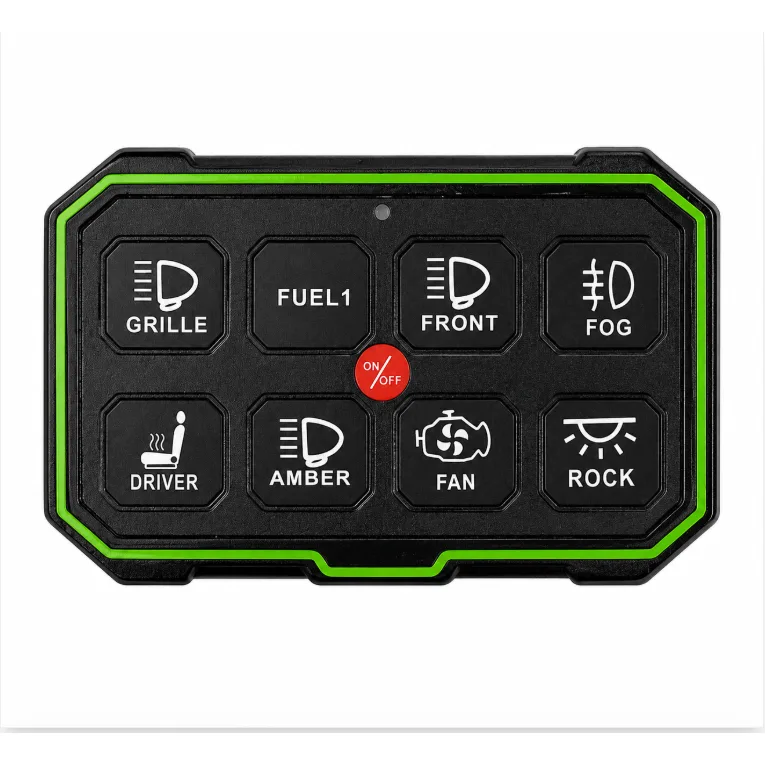
- Icon sticker sheets — 70 OEM icons
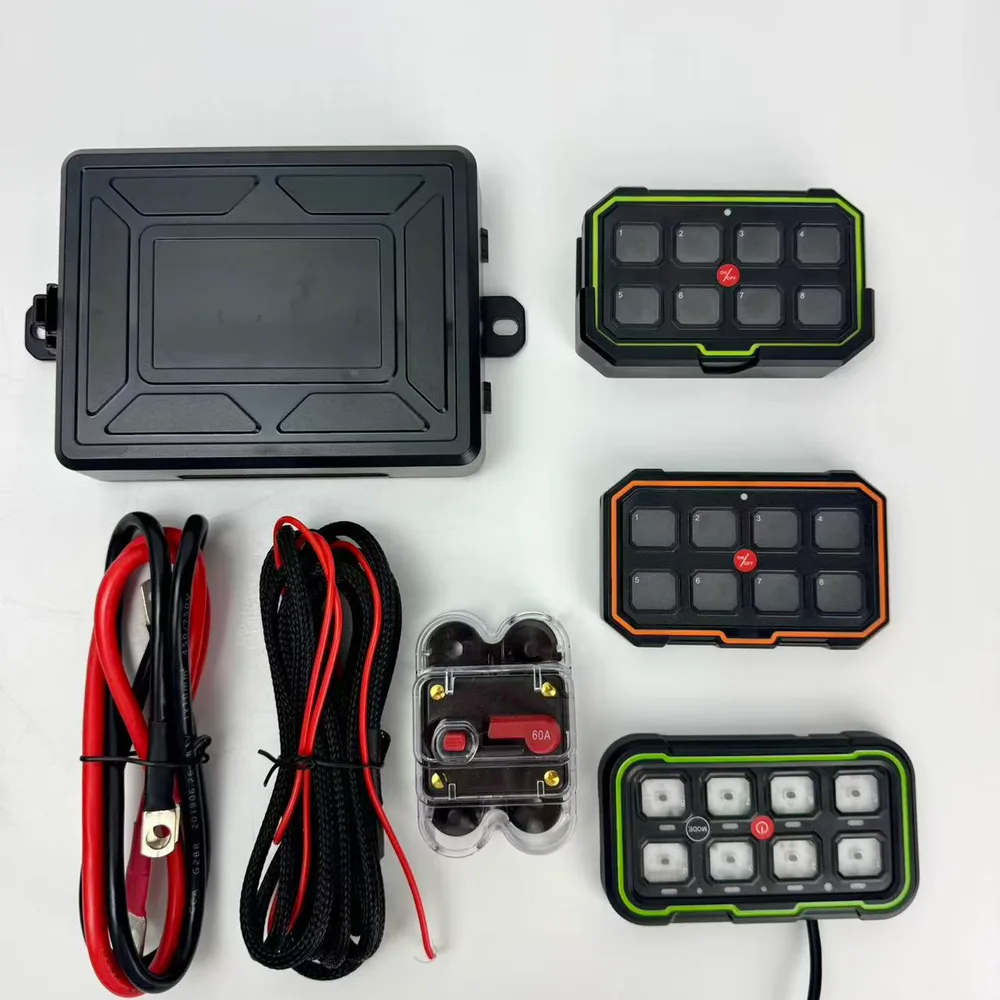
That last one matters more than it sounds. You get 70 stick-on icons, so you label each button for what you actually run — winch, compressor, light bar, fridge, rock lights — instead of living with whatever a factory printed. It’s a small thing that makes the panel feel like yours.
8 gangs, but not all equal
Here’s where a lot of cheap panels quietly cut corners: they give you eight switches that all share one small current limit. Great for eight LED strips, useless the moment you want to run a compressor.
This one splits the eight channels by amperage on purpose:
- 2 channels at 30A
- 2 channels at 20A
- 2 channels at 10A
- 2 channels at 5A
So you put the hungry stuff — air compressor, big light bar, winch accessory — on the 30A channels, and the small stuff — interior LEDs, rock lights — on the 5A ones. Total output is 60A across the panel.
That covers the second question we hear: “will 8 gangs handle everything on my build?” For most touring and 4WD setups, yes — as long as you match the load to the right channel, which the graded layout is designed for.
The app does more than turn things on
Because the wired panel carries Bluetooth, the phone app isn’t just a remote on/off. Through it you set:
- Backlight colour, per switch — so the panel matches the rest of the dash at night.
- Icon, per switch — the same 70-icon set that comes on the sticker sheets.
- Mode, per circuit — toggle, momentary, flashing or strobe.
- Grouping — one tap drives several circuits at once.
Grouping is the one thing only the app does. The rest the hardware already does on its own, and that’s deliberate: the app is another way into the same system, not a separate feature set you’d be stuck without.
Two things the panel handles without being asked. The wired panel’s backlight is light-sensing, so it sets its own brightness to suit the conditions — bright at midday, dim at 2am, nothing to remember. And the system has channel memory: switch the vehicle off, come back to it, and every circuit is the way you left it.
The two panels light themselves differently, which is worth knowing before you go looking for a setting that isn’t there. The wired panel is the automatic one. The remote’s backlight is white, with four steps — high, medium, low and off — and you move through them with a single press of the brightness key.
One loom vs no loom
If you’ve done both, this picture explains itself. Traditional 8-gang panels run every circuit as its own wire from the dash to the battery. This system runs the power once, to the control box, and switches everything there — so what crosses your firewall is a fraction of the mess.
Less wire through the firewall means a cleaner install, fewer joints to fail, and a lot less time under the dash.
Built to live outside
Rated IP65, so dust and the wash-down after a muddy weekend aren’t a problem in normal use. It runs on 12–24V, which means it drops into everything from a ute to a light truck without a second thought.
The warranty is two years, shorter than the five years on our wired panels, and deliberately so: the remote carries a rechargeable battery, and a battery is a consumable. The switching hardware underneath is the same TC-SW8B platform.
One thing we’d rather say plainly than bury: the wireless certifications for the radio — FCC ID and CE RED — are in progress, not finished, and are available for volume orders. If your market needs that paperwork in hand before you commit, ask us where it stands.
Want it in your own brand?
Here’s the third thing buyers ask — usually the shops and distributors: “can we put our own logo on it?”
We build as an OEM, so private label is on the table: whether your brand goes on the product, the packaging, or both — and what that changes in tooling, minimums and lead time. Like the rest of our trade terms, it isn’t a blanket policy. It’s quoted against the actual order and confirmed in writing.
If that’s the kind of thing you’re weighing up, get in touch — tell us what you’re building and we’ll walk you through where it lands.
Full specifications and photography are on the TC-SW8W 8-way wireless switch panel page. When it comes to fitting one, where the control box and the antenna go has the dimensions of every part and the one decision the kit adds. And if you’re still choosing what to hang off those eight circuits, lumens buy brightness, not beam distance is worth reading before you spend on driving lights.