
Your logo goes on in an afternoon. The rest is the work.
Every supplier will tell you to send your logo. That part takes an afternoon. Defining the product, and working out which certificates cover which markets, is the part that decides whether the programme survives its first year.
You have the channel and you have a name. What you are deciding is whether to put that name on hardware somebody else builds.
The pitch for that is always the same: send us your logo. It is true. It is also the smallest part of the job, and it is the part every supplier leads with because it is the part that sounds free.
What follows is the same conversation from our side of the table, including the bits that do not flatter us.
The order buyers ask in
Sit through enough of these enquiries and the sequence barely changes. Price first. Product quality second. Certification and minimum order come third and fourth — often not in the first email at all.
That order is understandable and it is backwards.
Price and quality are the two things you can still move after the fact. You can requote, re-spec, swap a model, change supplier on the next run. Certification coverage is the one that stops a container at a border or pulls a listing, and it is the hardest thing to fix late, because nobody can produce a certificate retroactively for a product that was never tested.
If you change one thing about your own first email, move certification to the top of it.
Three tiers, not one thing
Private label, OEM and ODM get thrown around as if they were the same service at three prices. They are three different amounts of work. Knowing which one you are actually asking for is what makes the rest of the conversation short.
Light. The product already exists. Your logo goes on the unit, you design the colour box, we pack it. No hardware changes. Most first orders belong here and there is nothing second-rate about it — a good product with your name on it sells.
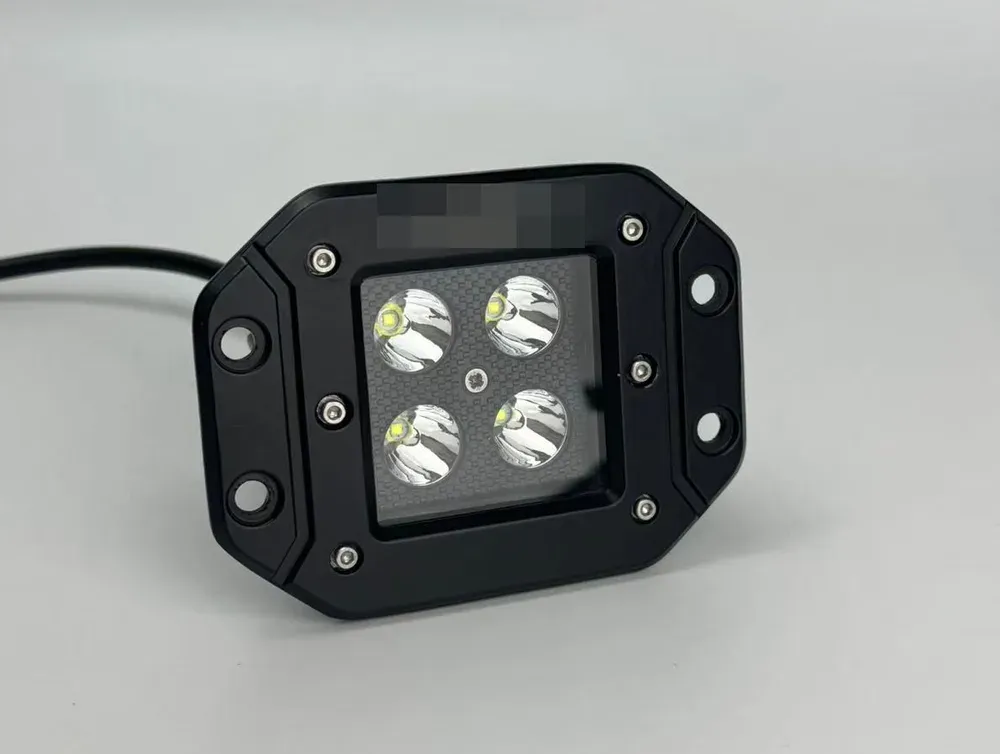
Medium. The product changes to your brief. On lighting that means lens and bezel colour, beam pattern, the harness, and what else goes in the box beside the lamp. On switch panels it means the key icons and silkscreen, and the bezel colour. The platform underneath stays; everything your customer looks at is yours.
Heavy. Tooling, or a product that does not exist yet. New enclosure shape, new mould, or a full brief-to-production development. This is real and we do it. Whether it is the right call is a plain question about whether the order volume behind it supports the outlay, and that is a conversation, not a menu item.
Most brand owners arrive convinced they need the heavy tier. Most need the light one. Some genuinely need the middle. The way to tell: write down what a customer would have to see for the product to read as yours, then count how much of that list is artwork.
Where your brand can actually go
Five surfaces, and they are not equal:
- The product face — printed logo and silkscreen. On a lamp, lens and bezel colour go with it.
- The manual — your name, your language, your support details.
- The colour box — your design, start to finish.
- The outer carton — shipping marks, carton quantity, your barcode.
- The enclosure shape — a different housing needs a different mould.
Four of those five are files you send. The fifth is steel somebody has to cut, and that gap is the whole distance between the light tier and the heavy one. Most programmes that slip, slip on not knowing which side of it a change falls.
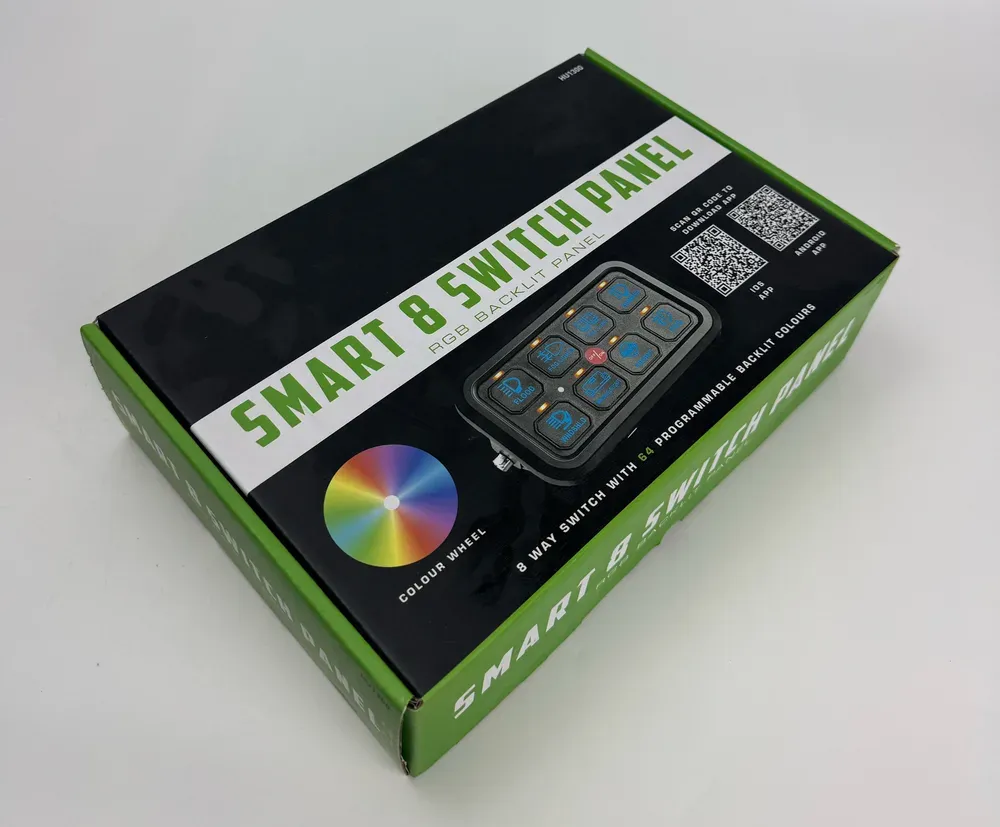
One worked example, because it is the clearest evidence that the middle tier is real rather than a brochure line.
Our 8-gang panels — TC-SW8, TC-SW8B and TC-SW8W — ship with 70 icon options as standard. The 12-way carries 70 OEM decals, the 6-way and the 4-way 60 icons each, and the relay 6-way 24. The touchscreen panel has none, and that is not an omission: its icons live on the screen, so there is nothing to print on a key.
Note what that is, though. Those sets ship in the box for the person fitting the panel, so they can label a switch winch or compressor instead of living with whatever was printed at the line. It is a product feature, not a branding service. Custom icon sets, printed logos and retail packaging are the separate thing, and they sit in the middle tier where they belong. A supplier who blurs the two is selling you something that was already in the box.
The step almost everyone underestimates
It is not the logo, and it is not the certificate. It is that a branded product still has to be defined by somebody, and once your name is on it, that somebody is you.
Brand owners arrive thinking private label means swapping a logo. Then the questions start. Which beam pattern for your market. Which bezel colour. What goes in the box — a harness, a bracket set, a spare lens. Which icons on which key. Every one of those is a decision that used to be made for you, and now is not.
The colour box is the one that surprises people most. It is your design: artwork, dieline, barcode, translations, and the round trips on a print proof until the colour on screen matches the colour on card. That is real work by your team or your designer, and it runs alongside everything else rather than after it. Budget attention for it, not just money.
None of this is an argument against doing it. It is the actual shape of the job, and knowing the shape early is what stops a three-month programme turning into a nine-month one.
Certification does not travel with your logo
This is the part worth reading twice.
A certificate is issued to an entity, for a specified model, against a named standard, for a market. It is not attached to how a product looks and it is not attached to a brand. Printing your name on the housing does not create a certificate, does not transfer one, and does not extend one to a market it never covered.
So the answer to “is it certified?” is never yes or no. It is: certified to what, by whom, covering which models, valid where.
Four things to ask for, every time, of any supplier:
- the certificate number
- the issuing laboratory
- the standard it was tested against
- which models the certificate covers — the one people forget, and the one that most often does not say what the seller implied
Then check that coverage against your own market’s rules. A mark that satisfies one market is not automatically the mark another market asks for. What obligations sit with you once the box carries only your name is a question for someone qualified where you sell — we can tell you what exists and hand you the paperwork, and we cannot tell you what your market will make of it. Any supplier who says they can is guessing on your behalf.
Here is where we stand, plainly, because a guide that only warns you about other people is not much of a guide:
- Switch panels hold CE (EMC Directive 2014/30/EU), FCC Part 15 Subpart B, RoHS 2.0 and a REACH SVHC screening report, issued by Shenzhen HTT Technology. The certificate numbers are published on the product pages, and the scope covers the 2- to 24-channel range — every panel we sell.
- LED headlights hold CE, FCC and RoHS 2.0 from the same laboratory, under their own certificate numbers — and against lighting standards rather than the panels’ ones. No REACH report on that line. Which is the point: two ranges from one supplier, and the paperwork is not interchangeable.
- Driving lights, work lights and light bars hold none. Those fields are empty on this site and they stay empty until certificates exist. If you are building a lighting brand on our light bar range, that is a gap you plan around, not one you find at customs.
- The radio approvals for the wireless panel — FCC ID and CE RED — are in progress rather than finished, and available for volume orders.
We would rather write that down than have you find it in month four.
Two clocks, and they get confused constantly
Brand owners routinely quote one timeline for work that runs on two completely different schedules.
Developing something that does not exist yet runs around three months, depending on the product: design and development, then tooling, then a working demo. That is the heavy tier, and the clock starts when the brief is settled — not when the first email lands.
Producing something that already exists runs around 20 to 25 days from material to finished goods, depending on what the order asks for. That is the light and medium tiers, and it is the clock most people are actually asking about.
Treat those as planning horizons rather than a quoted delivery date — the schedule for your order is confirmed against your order, in writing. But keep the two apart in your own planning. Budget three weeks for something that has to be developed first and you miss a season. Budget three months for a straight rebrand and you leave a quarter of selling time on the table.
Questions worth asking before you sign
Take these to any supplier, us included:
- Who holds the certificate, and which models does it cover? Ask for the scan, not the claim.
- Which of my changes are artwork and which need tooling? The answer sets your timeline more than anything else on this list.
- If I pay to change a design, who owns the change? Settle it before the drawing exists, not after.
- When my name is on the box, how does a warranty claim actually run? Who the end customer contacts, who ships the replacement, who carries the cost.
- Can I reorder the identical product in two years? Components go end-of-life. A product that changes quietly underneath you is not one you can build a brand on.
If a supplier gets impatient at question 1 or question 5, you have learned something useful for the price of an email.
Where we land
We are a brand and supplier, and we run OEM, ODM and private label programmes across all five lines. The OEM and private label page sets out what changes at each tier, and wholesale supply covers ordering across the range.
What we do not publish is a number for any of it. Minimums, tooling, pricing and terms are quoted against a real order and confirmed in writing, because a blanket figure on a web page is either wrong for your order or a bluff. Tell us what you are building and which markets it is going to, and we will tell you which tier it lands in — including when the honest answer is that you do not need the heavy one yet.
Start an OEM or private label enquiry, and put the certification question first.
If the switch line is what you are looking at branding, sizing a switch panel by total current covers what your customers will ask once your logo is on it. And the wireless and wired 8-gang system is the platform most branded panel orders start from.