
Nobody sends a light bar back for being dim
Every enquiry opens with the emitter question — which chip, how many. The claims that arrive a year later are almost never about brightness. Both deserve a straight answer, and they are not the same question.
Two questions come with every light bar enquiry. Only one of them gets asked out loud.
The one that gets asked is about the emitter. Which chip, how many, one row or two. It is a fair question — on a spec sheet it is the closest thing to brightness that anyone can actually verify.
The one nobody asks is what makes a bar come back. Very few of them do — warranty claims on our light bars run at 0.2 to 0.3 per cent. But of the handful that do, almost none come back dim. They come back wet.
This is written for the people who deal with both — distributors answering the first question, and workshops that wear the second one.
The second row is the answer to the chip question
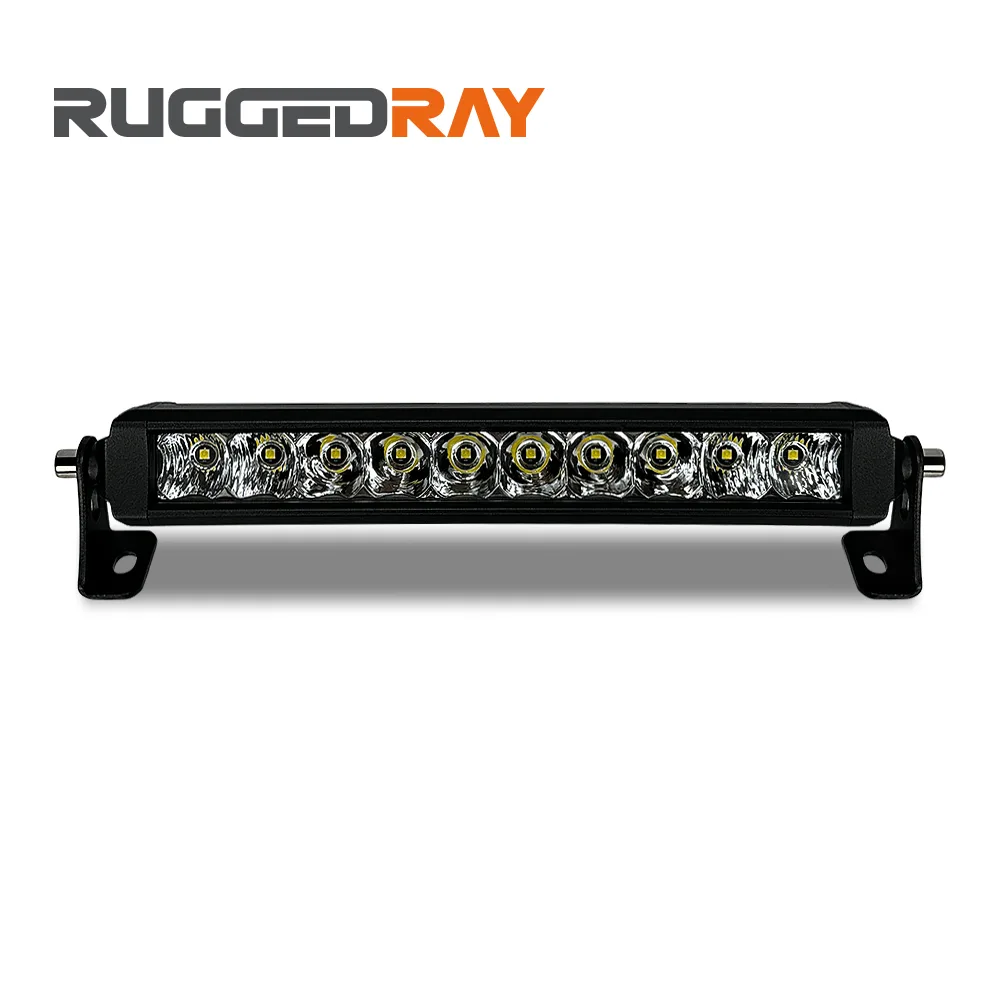
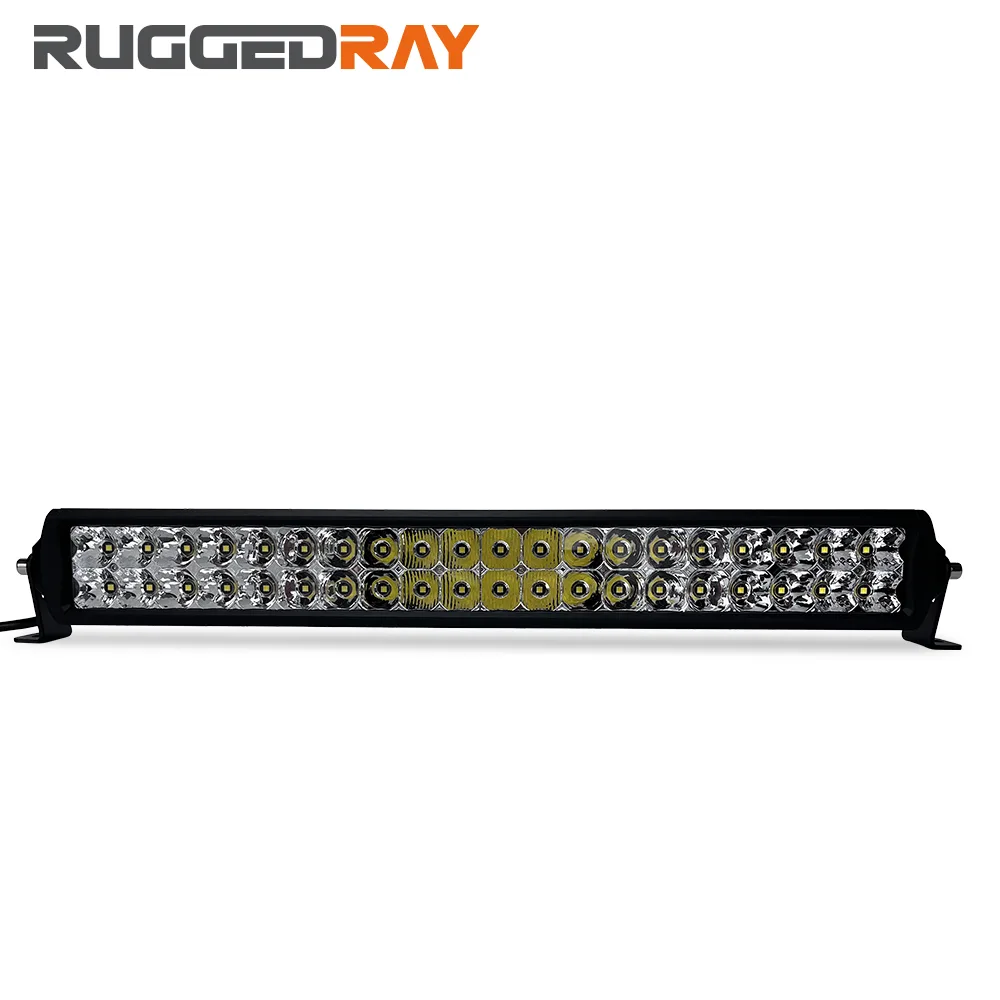
Put the two halves of one series side by side and the whole thing is visible in four columns. TC-B115 is a single row. TC-B116 is the same ladder in two rows.
| Length | TC-B115 — one row | TC-B116 — two rows |
|---|---|---|
| 12“ | 10 LEDs · 50W | 20 LEDs · 100W |
| 22“ | 20 LEDs · 100W | 40 LEDs · 200W |
| 32“ | 30 LEDs · 150W | 60 LEDs · 300W |
| 42“ | 40 LEDs · 200W | 80 LEDs · 400W |
| 52“ | 50 LEDs · 250W | 100 LEDs · 500W |
Read it across, not down. At every single length, the twin row carries exactly double the emitters and exactly double the wattage. A 22-inch bar is either 20 LEDs and 100W or 40 LEDs and 200W, and the length on the bracket is identical.
So when a customer says twin row is brighter, they are right, and the mechanism is not mysterious: it is the count. There is no optical trick and no better grade of chip involved. There is a second row of emitters.
What it costs is also not mysterious:
- Height. A twin-row bar is roughly twice as tall. On a bull bar that is nothing. Behind a grille opening or under a bonnet lip, it is the whole decision.
- Current. Double the wattage is double the draw, and that lands on the switching, the cable and the fuse — see below.
- Frontal area. More bar in the airflow, and more bar for a branch to catch.
None of that makes one better than the other. It makes them two different answers to “how much light can I fit in this opening”, which is the question a workshop is actually solving.
What we will not print on a bar page
Here is the part that costs us something to say.
Across every light bar series we list, three columns on our build sheet are empty: lumens, ingress protection and operating voltage. Not disputed — empty. So the product pages render “to be confirmed” and this article gives you no lumen figure, because the alternative is to borrow one from a supplier document, and a number on a brand site is a promise.
There is a second gap worth naming, because it is the exact question this article opened with. The sheet states each size step two ways — emitter count with bar wattage, and a separate per-emitter column — and on two series those two statements do not agree with each other. One of them is wrong on each, and nothing on file says which. So the table above quotes only the figures the size ladder states outright, and no per-emitter wattage appears anywhere in this article.
What you do instead is ask. Name the series and the length you are quoting, and we go back to the line and confirm it in writing against that model. That is slower than reading it off a page, and it is the only version that survives a customer holding you to it.
Where the range as a whole stands, and this we do say: the series run branded emitters — Osram, Cree and JingNeng — the ladders start in single-figure inches and run past fifty, and every series on the line carries a five-year warranty.
They come back wet
Two numbers, and the first one sets the scale of the second. Warranty claims on our light bars run at 0.2 to 0.3 per cent. Within that fraction, water ingress is very nearly all of it. Brightness is not on the list.
Both halves of that matter. A bar coming back at all is rare. And when one does, the reason is consistent enough that it stops being a statistic and becomes a design brief — which is why the sealing is where the work goes on this product, and why the three habits below are worth five minutes at fitting time.
The mechanism is always the same. Water gets in, sits on the board, and the emitters go one after another — usually a cluster at one end rather than the whole bar at once, which is the tell. The LED did not wear out. It drowned.
Heat is the failure everyone expects and it is not the one that arrives. We get asked about grille blockage and coolant temperature more often than the subject deserves; a bar mounted in front of a radiator is a thermal question for the vehicle, not for the bar, and it is not what the claims are about.
Three habits, and they are all at fitting time rather than buying time:
Do not put the pressure washer on the seam. The bond between lens and housing is the longest joint on the product and the only one that ends up under a jet at close range. Wash the vehicle, not the light.
Point the cable entry down, and leave a drip loop. Water runs along a cable. Given a gland that faces up, it runs into one. Every gland on every brand is a fitting that was tightened by somebody, so check it after the first hard trip — corrugations undo things.
Never drill the housing. If the bracket does not suit the mount, change the bracket. A hole through the case is a hole through the sealing, and it fails the warranty and the bar in that order.
Worth saying plainly: the five-year warranty on this line covers a bar that lets water in through something we built. It does not cover a hole a fitter made. Those two get argued about, and the argument is much shorter when the fitting notes above are what happened.
Length is one number. Current is the other.
A 240W bar draws about 20A at 12V. That is arithmetic on the wattage rather than a measured specification — but it is the number that decides what the bar can hang off.
It matters because switch panel channels are not interchangeable. On a typical eight-way panel the channels are graded, and a 20A load belongs on a 30A channel and will not live on a 10A one. If the build is still being specified, sizing a panel by total current rather than switch count is the piece to hand across, and the switch panel range lists the channel ratings model by model.
This is the part of a light bar sale that gets settled last and should be settled first. The bar is chosen on how it looks in the opening. What it needs is a circuit that can carry it.
EMC, and the buyers who ask for it
European customers ask us for EMC — interference testing — on light bars. Buyers elsewhere rarely raise it.
The honest position, and it is the same one on every light bar page: we hold no CE, FCC or RoHS certificate for this line, and we will not borrow one from a supplier sheet. Our switch panels and our LED headlight bulbs hold their own. A certificate names the product it was issued against, so those do not reach the light bars, and anyone telling you otherwise is reading a certificate for a different product.
Certification can be arranged where an order needs it. Which marks, against which standards, and where testing sits in the schedule are settled with you and confirmed in writing, like every other term of an order.
Whether you need one depends on where you sell, and that is your call rather than ours — tell us what you have to meet. Where a mark is required it is a condition of selling, and neither of us can wave it through.
Sizes are your call, and the ladder is built for that
We are not going to tell a professional buyer what length to stock. You know the opening, the bull bar and what your customers ask for, and the enquiries that reach us are specific from the first message.
What is worth knowing is that the ladders are not continuous, and they differ series to series. TC-B107 climbs in nine steps from 6 to 48.5 inches. TC-B117 has two, at 7.5 and 14 inches. TC-B118 runs six steps from 9 to 49. So the move is to fix the mounting position first, then pick the series whose ladder has a step near it — not to pick a series and hope it comes in your length.
Which beam the optic produces is the other half of that, and it is genuinely separate from both length and wattage. TC-B103 makes the point on its own: it is listed in a 2D optic and a 4D optic on an identical nine-step wattage ladder, same lengths, same watts, different beam. Spot against flood, and what the optic actually changes covers that properly, and lumens against beam distance covers why the brightest number on a page is not the one that reaches.
The short version
More chips is more light, and a second row is how you get more chips into the same length. That is the question buyers ask, and the answer is that simple.
Then plan for the failure that actually happens. Seal, cable, bracket. A bar that never lets water in outlives the vehicle it was fitted to.
Every series on the line carries a five-year warranty and run branded Osram, Cree or JingNeng emitters — the full light bar range lists every one with its size ladder. To build them under your own brand, how private label actually works is the honest version, and the conversation starts here.