
Stocking LED headlight bulbs: sockets, heat and what the certificate covers
A replacement headlight bulb is a safety part before it is an upgrade. What follows is what we would want a distributor to check on our range, or anyone else’s, before the first carton is ordered.
A halogen headlight rarely fails all at once. It gets dimmer over a long stretch of ownership, the driver adjusts to it night by night, and nobody notices until the new bulb goes in and the road suddenly has edges again. That slow fade is the case for an LED replacement, and it is also why we treat the bulb as a safety part first and an upgrade second.
For a distributor, the questions come in a different order from the driver’s. Will one part number cover the vehicles your customers bring in? What keeps it alive inside a sealed headlamp? And what does the paperwork on the box actually approve?
Stock by base type, not by model
The LED headlight range is sold by the base the bulb plugs into, and most of the range covers the same set of bases. The T9-150W, T7-120W, T8-75W and T3-40W are each made in the dual-beam H4, H13, 9004 and 9007, and in the single-beam H1, H7, H11, 9005, 9006 and 9012. The PP-30W covers the same single-beam bases and H4 on the dual-beam side.
That changes how you plan a shelf. You are not stocking four models in one fitment; you are choosing which model, at which output, covers the bases your local vehicle mix actually uses, and then going deep on the three or four that sell. A dual-beam base such as H4 carries low and high beam in one bulb, so one pair does both jobs on vehicles built that way, while a single-beam vehicle takes separate bulbs for each.
The D bulbs-35W are a separate job altogether. They replace xenon (HID) bulbs, in the D1S, D2S, D2C, D2R, D3C, D4S, D5 and D8 bases, for vehicles that left the factory with xenon headlamps rather than halogen ones.
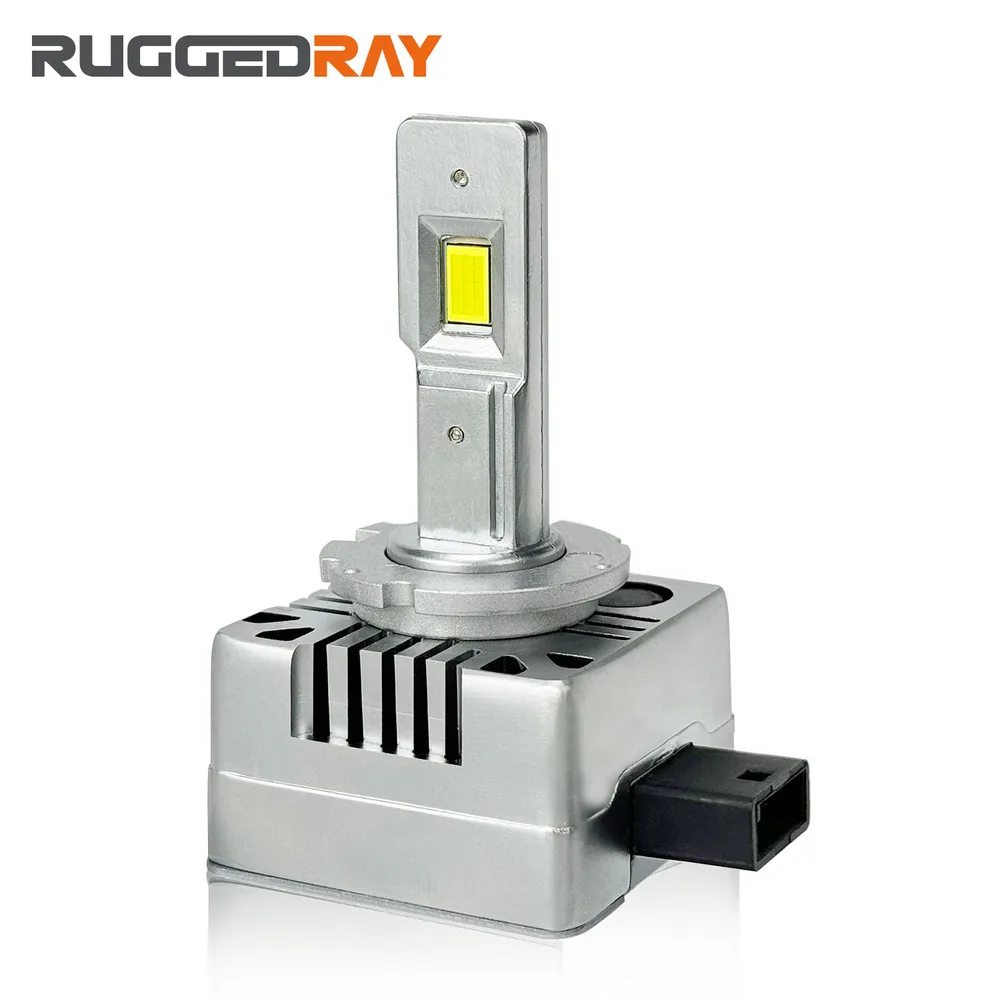
The heat sinking is the part you are paying for
An LED makes less heat than a halogen filament for the same light, but it is far less tolerant of the heat it does make. Its output and its life both depend on how fast that heat leaves the chip, and inside a headlamp there is not much room for it to go: the bulb sits in a closed housing, often with a dust cap pressed on behind it.
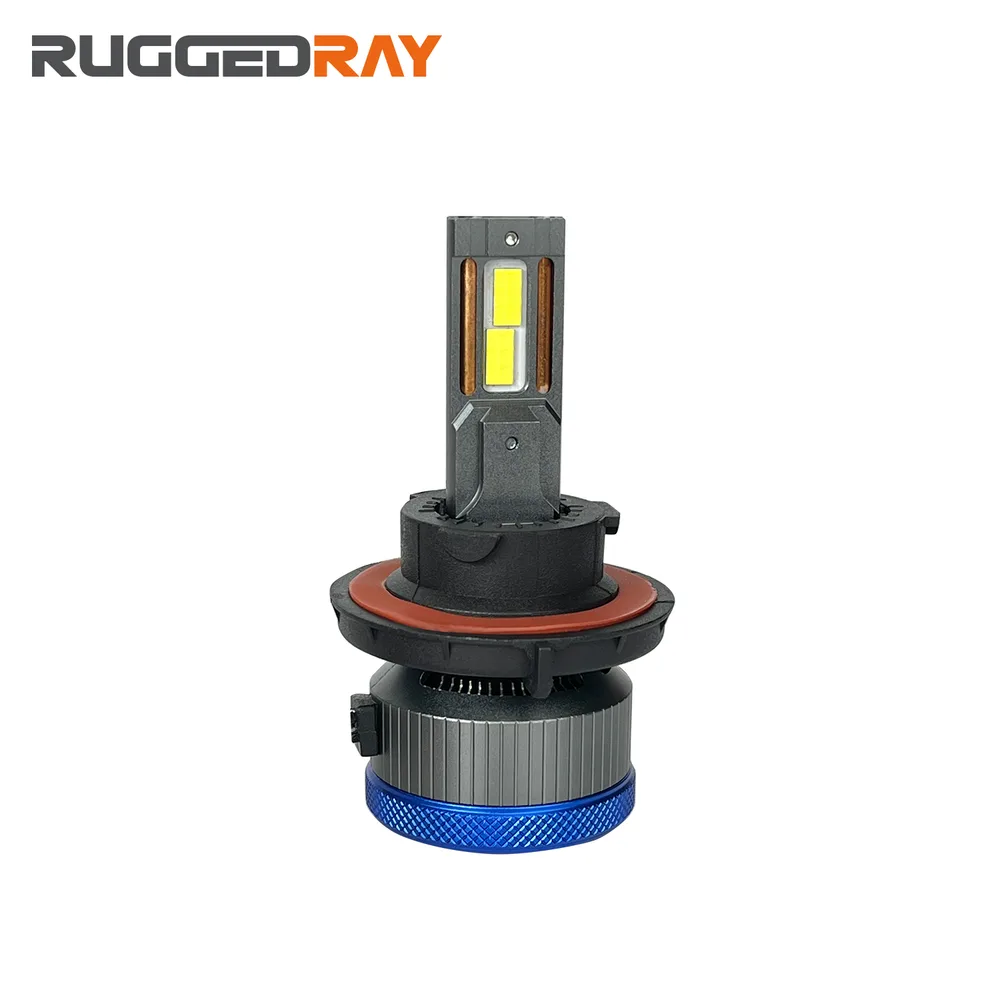
So the back half of the bulb matters as much as the front. On the T9-150W and T7-120W the specification is a dual copper tube with a fin-style heat sink, and in the photograph below you can see the copper running alongside the chips to carry heat back to the finned base. The T8-75W, T3-40W and PP-30W rows name the chip package instead, CSP4070 on the T8 and CSP3570 on the other two.
Warranty is set per model, and it does not simply rise with output. The T7-120W carries five years, the T9-150W, T8-75W and D bulbs-35W carry three, and the T3-40W and PP-30W carry two. If you resell with your own warranty on top, quote each model on its own term rather than one figure for the range.
Reading the numbers on a headlight bulb
The listed light output runs from 3,000 lumens on the PP-30W to 12,000 on the T9-150W. Treat any lumen figure on a headlight bulb, ours included, as a basis question before a brightness question: a figure quoted for a pair reads twice as bright as the same bulb quoted alone. On two of our own rows the specification text quotes a figure per pair or per set, and we are confirming in writing which basis the lumen column uses before we put a per-bulb number next to it. Ask any supplier the same question.
Beam distance is the figure we do not publish for this line. A “220-meter beam distance” line turns up word for word in the product documents for two different headlight models, which tells you it was written once and copied rather than measured on either. How far a headlight reaches depends on the bulb and the headlamp it sits in together, and lumens and beam distance measure different things even on a lamp that controls its own optics.
What CE, FCC and RoHS cover on these bulbs
The headlight line holds three certificates, issued on 2024-12-31 by Shenzhen HTT Technology, and the range page lists them with their numbers. They are worth reading closely, because the mark on the box is the first thing a distributor’s own customer will ask about.
- CE is issued under the EMC Directive, 2014/30/EU. It covers electromagnetic compatibility: whether the bulb puts out interference that upsets a radio or other electronics, and whether it keeps working when interference reaches it.
- FCC is a Supplier’s Declaration of Conformity under Part 15, which is also about emissions.
- RoHS 2.0 covers restricted substances in the materials.
None of the three measures light output, beam pattern, colour or glare, and none of them is a type approval for a headlamp or for the bulb inside one. Whether an LED replacement may be used on the road depends on the market and sometimes on the vehicle, so check what your target market requires before you stock for on-road sale, and tell us what you have to meet.
The certificate scope is written as a list of bases, H1 through to D8, rather than a list of our model names, and the range is sold by those same bases. That is what lets a buyer match the certificate to the bulb in the carton. It also reads “12V LED headlight bulbs”. We have not published an operating voltage range for this line yet, so if you sell into 24V trucks, ask us about the specific model before you order.
The lights you add are a different circuit
A headlight bulb runs on the circuit the vehicle already has: the factory switch, the factory wiring, the factory fuse. Driving lights, light bars and work lights do not, and that is where most of the electrical trouble on a 4x4 build starts. If your customers are adding lamps as well as replacing bulbs, the switch panel range is how we wire them, and why the panel comes before the lights explains the order we would buy in.
Stocking it under your own brand
Private label, OEM and ODM are available on the headlight line, and the three are different jobs with different clocks. One point carries over from the certificate section: a certificate names the product and the company it was issued to, so it does not transfer with a logo. If you want to know what a headlight bulb under your name would need, send us the bases and markets and we will start from there.